Poodle Pâtisserie
What happens when you take the personality, history, and cultural baggage of a dog breed seriously enough to build it a business? Apparently, you get an extremely opinionated French bakery.
If the Poodle were a brand, she would obviously be a luxury French pâtisserie.
Not a bakery.
Not somewhere you grab a blueberry muffin and a drip coffee on your commute.
A pâtisserie.
Because Poodle is intelligent, meticulous, extravagant, European, and just precious enough to have very strong opinions about laminated dough.
Welcome to Poodle Pâtisserie.
-
Luxury French Pastries
Poodle specializes in impeccably executed French pastry made with exceptional ingredients and traditional techniques.
She's not interested in deconstructing the croissant.
She doesn't need to fill it with Flamin' Hot Cheetos to get TikTok's attention.
Poodle's fundamental position is much simpler:
The classics don't need disrupting. They need to be done properly.
-
The Almond Croissant
It's an almond croissant as big as your face.
They make a fixed quantity every morning. They're usually gone by 10 a.m. There is routinely a line around the block.
But with zero red-pill manosphere vibes.
The scarcity isn't the strategy. Poodle simply refuses to compromise the product in order to make more of it.
When today's croissants are gone, they're gone.
Try again tomorrow.
-
The difference is in the doing.
Poodle is built for people who believe exceptional ingredients and time-honored technique produce a fundamentally different result.
This isn't nostalgia masquerading as craftsmanship. Nor is it innovation for innovation's sake.
Poodle isn't asking:
How can we reinvent French pastry?
She's asking:
How fucking good can we make French pastry?
Those are very different businesses.
-
Tradition without standards is just nostalgia.
This is the conviction organizing the entire brand.
Tradition alone isn't inherently valuable. Doing something the way it's always been done means very little if you're doing it badly.
Poodle preserves the techniques because they work.
That belief determines the ingredients she sources, the products she makes, the quantities she produces, the people she hires, and even the places she's willing to expand.
If growth requires lowering the standard, Poodle doesn't need the growth.
-
Who carries the Poodle box?
Hamptonites with Van Cleef & Arpels Alhambra stacks who are somehow still doing the Scandinavian hairline treatment.
They have Equinox memberships and a Pilates studio they prefer.
They spend money on flowers that look casually thrown together but cost $185, farmers' markets, Net-a-Porter deliveries, natural wine, and children's clothing that no three-year-old has any business wearing.
They don't necessarily describe themselves as foodies.
They just know where the good things are.
And Poodle becomes part of the weekend ritual.
You don't ask whether anyone wants pastries.
You say:
“I'm getting Poodle.”
Everyone knows what that means.
-
Manhattan. East Hampton. That's it.
Poodle has exactly two sister locations: one in Manhattan and one in East Hampton.
They're virtually identical inside.
Cream stone. Dark wood. Deep green. Hits of that unmistakable Poodle pink.
The sales associates are equal parts bubbly and snobby.
They are genuinely delighted to see you.
They are also genuinely horrified that you just asked whether the pain au chocolat is vegan.
The packaging is beautiful enough that carrying it down the street becomes advertising: heavy paper, impeccable construction, dramatic typography, no twee little illustrations of rolling pins.
And there is no manufactured “signature scent.”
It smells like butter.
Because there are actual fucking pastries in the building.
-
American flour.
If you have to ask, don’t bother.
Poodle has already explained this once.
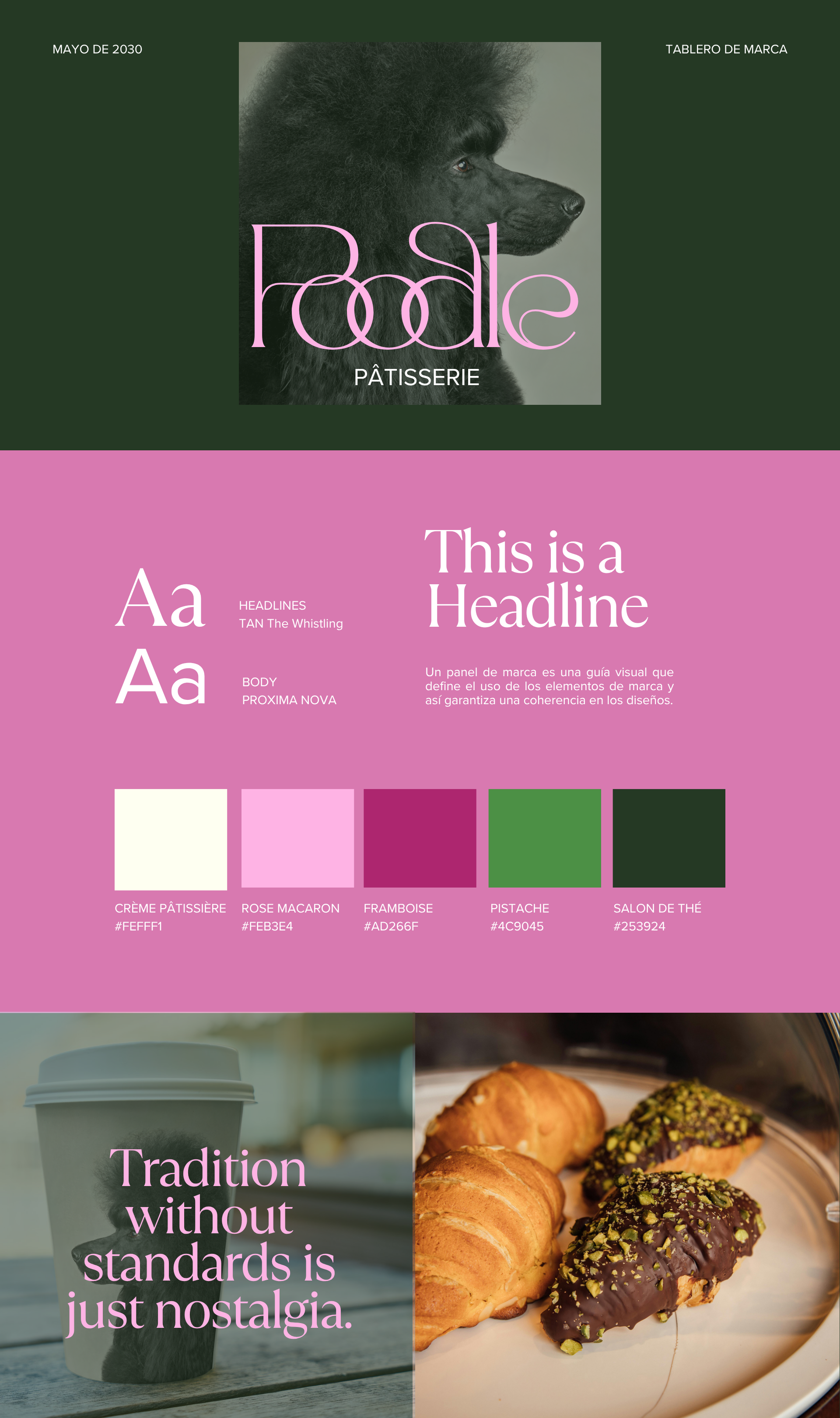
THE VISUAL IDENTITY
French fashion editorial meets pâtisserie.
Poodle shouldn't look like a stereotypical French bakery.
No Eiffel Towers.
No chalkboards.
No faux-vintage bicycles with baguettes sticking out of the basket.
And absolutely nothing rustic.
The visual identity treats Poodle less like a neighborhood bakery and more like a fashion house that happens to make carbohydrates.
The editorial typography brings the luxury and precision. The Poodle portrait gives the brand its cultivated extravagance without turning it into a cartoon. The photography is tactile, indulgent, and restrained.
And the palette lives somewhere between French pastry case and fashion editorial:
Crème Pâtissière — the soft cream foundation.
Rose Macaron — unabashedly Poodle pink.
Framboise — saturated raspberry for the drama.
Pistache — bright, culinary green.
Salon de Thé — the deep green that grounds everything and gives the sweeter colors some authority.
The result is feminine without becoming saccharine, French without becoming costume, and luxurious without becoming sterile.
Which is exactly what Poodle needed to be.
THE BRAND IN ONE SENTENCE
Poodle Pâtisserie is what happens when pleasure develops standards.
And she would rather close the bakery than use American flour.
A note from Elle
I'm a brand strategist who normally builds brands using birth charts as the source material.
This time, I used a Poodle.
Because whether the source material is astrology, a founder's worldview, or an exceptionally coiffed dog, the exercise is ultimately the same:
Find the organizing idea strong enough that the brand starts making decisions for you.
Once Poodle became Poodle, I didn't need to arbitrarily choose whether she was rustic or editorial, mass-market or exclusive, experimental or traditional.
She started rejecting the wrong answers herself.
And that's when a brand stops being a collection of aesthetic choices and starts becoming an identity.