Labradoodle Resort Sportswear
What happens when a Labradoodle graduates from an SEC school, inherits her grandmother's julep cups, and discovers that polyester exists?
She starts a clothing company.
If the Labradoodle were a retail brand, she would sell premium American resort sportswear.
Think East Coast prep. Country clubs. Beach clubs. Boats. Summer houses. Critter pants. Madras. Clothing specifically purchased because somebody invited you somewhere for Memorial Day weekend.
The aesthetic is old money.
The customer may or may not be.
Welcome to Labradoodle.
-
Premium American Resort Sportswear
Labradoodle makes the kind of clothing worn wherever affluent Americans have historically gathered to drink outside.
Chinos. Oxford shirts. Cable knits. Linen. Canvas. Madras. Resort dresses. Swimwear. Sweatshirts purchased somewhere coastal and worn for the next fifteen years.
The brand lives somewhere adjacent to Lilly Pulitzer and Vineyard Vines—but with an almost fanatical commitment to traditional American sportswear and domestic manufacturing.
It's cheerful.
It's expensive.
It's extremely well made.
And it knows precisely which rules it's breaking.
-
The Go-To-Hell Pant
Labradoodle's cult product is also known as the Eff You Trouser.
Take traditional embroidered critter pants.
Cross them with patchwork madras.
Then cover them exclusively in tiny fluffy Labradoodles.
No Labs.
No retrievers.
No tasteful little sailboats.
No lobsters.
Fluffy Labradoodles only.
They're beautifully constructed, unapologetically ridiculous, and expensive enough that wearing them communicates:
“I know exactly how stupid these are. That's why I bought them.”
They are equally appropriate for a yacht club, a summer wedding welcome party, or drinking a lager somewhere your father knows the owner.
-
Patriotism without the merchandise.
Everything Labradoodle makes is made in the USA.
Not designed here.
Not assembled here.
Made here.
Their commitment to American manufacturing borders on patriotic fanaticism—and yet there isn't a bald eagle, distressed flag, or 1776 graphic anywhere in the brand.
Not a single star or stripe appears out of context.
The one exception is the beach umbrellas.
They're striped.
They're also still made from wood, weigh approximately as much as a small sedan, and require two people to carry them across the sand.
Because Labradoodle's patriotism isn't something you print on a T-shirt.
It's something you practice through production.
-
Whimsy without tradition is just kitsch.
Labradoodle is ridiculous.
Deliberately.
But there's a difference between knowing the rules well enough to play with them and simply throwing novelty onto a product.
Underneath the fluorescent colors and tiny embroidered dogs are deeply established American sportswear traditions.
Madras.
Critter pants.
Oxford cloth.
Chinos.
Cable knits.
Natural fibers.
Proper construction.
Whimsy works because the foundation is serious.
Tradition gives Labradoodle something to fuck with.
Without that foundation, you're just selling novelty clothing.
-
Old-money taste. Nouveau-pauvre finances.
Labradoodle's customer is intimately familiar with the cultural codes of American prep.
They were in the Greek system.
They have won a drinking game with a degree of competitiveness normally reserved for NCAA athletics.
They own a set of sterling-silver julep cups, probably engraved with their grandmother's initials.
They have attended weddings with multiple dress codes.
They understand that “khaki” is not one thing.
They probably own something needlepointed.
They know at least enough sailing terminology to avoid being immediately exposed.
And pretty much everything they've ever accomplished in life happened, at least partially, because they knew someone who knew someone.
That does not necessarily mean they're rich.
Maybe the grandparents had money.
Maybe the parents have money.
Maybe they currently have $14,000 in credit-card debt while spending Memorial Day at somebody else's family house on Nantucket.
The financial situation is irrelevant.
They know the codes.
Old-money aesthetic. Nouveau pauvre reality.
-
A visual party with rules.
Walking into Labradoodle is either an assault or a haven for your senses.
There is fluorescent lighting.
There is an Ocean Breeze candle that has apparently been burning continuously since the store opened.
There are stacks of aggressively cheerful clothing folded with military precision.
Everything feels simultaneously prepared to crack open a case of lager and absolutely judge you if you can't handle your alcohol.
The staff are college-aged kids.
They're friendly.
They're attractive.
They know where every size medium is.
They know essentially nothing about anything the company made more than five years ago.
The flagship is in Georgetown, Washington, D.C.
Other locations live primarily in high-end malls with King of Prussia energy—places where buying $300 Labradoodle trousers somehow makes perfect sense in the context of your afternoon.
There are seasonal resort locations and pop-ups where appropriate.
-
Polyester.
No.
Not even a little.
Not even if it performs better.
Not even if it wrinkles less.
Not even if you call it a proprietary technical fiber.
Labradoodle would rather sell you a linen shirt that looks like it spent the afternoon crumpled underneath your ass than solve the problem with polyester.
Wrinkles are evidence that you're wearing a natural fiber.
Your grandmother would understand.
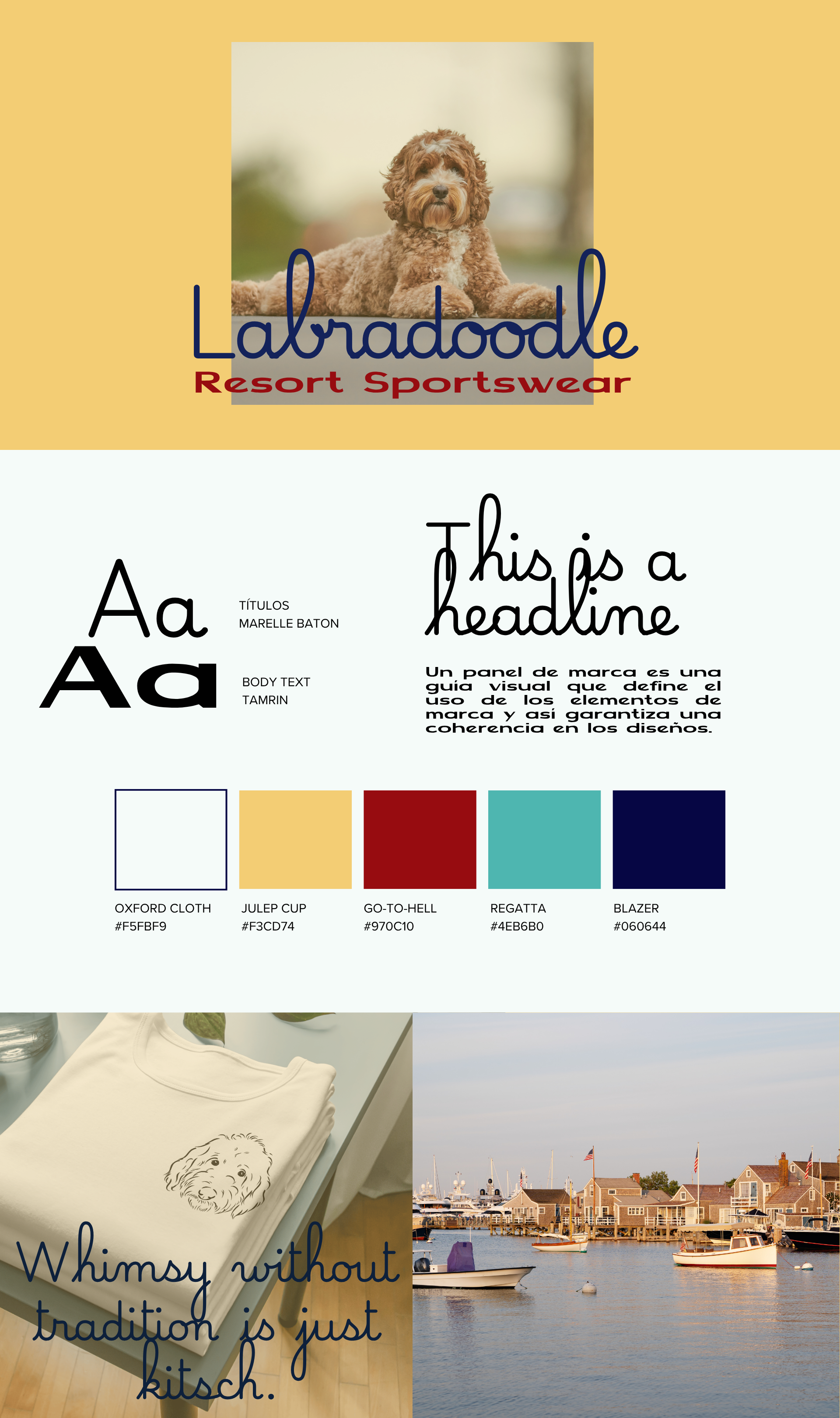
THE VISUAL IDENTITY
Labradoodle should feel like a visual party happening inside a very established set of rules.
Butter yellow.
Navy.
Red.
Aqua.
White.
The palette is unapologetically cheerful, while navy and white keep the whole thing anchored in traditional American prep.
The handwritten wordmark brings some of the exuberant resort-fashion energy of Lilly Pulitzer without pushing the entire identity into Palm Beach maximalism.
The imagery lives in marinas and beach clubs.
Weathered wood.
Canvas.
Striped umbrellas.
Sweatshirts.
Sailing hardware.
Summer sun.
Things that have been owned long enough to look better slightly beaten up.
The identity isn't quiet luxury.
It isn't heritage menswear.
And it isn't novelty resortwear.
It's American prep with its tie loosened after three beers.
And somewhere, inevitably, there is a tiny fluffy Labradoodle.
THE BRAND IN ONE SENTENCE
Labradoodle makes ridiculous clothes for people who take tradition very seriously.
A note from Elle
I'm a brand strategist who normally uses astrological birth charts as the source material for building brands.
Today I used a Labradoodle.
And Labradoodle demonstrates something important about brand identity:
Constraints don't kill creativity. They make creativity recognizable.
Once we know that whimsy without tradition is just kitsch, the apparent contradictions stop being contradictions.
The pants can be ridiculous because the construction isn't.
The colors can be loud because the silhouettes are familiar.
The brand can be fiercely patriotic without printing a flag on anything.
The customer can be irreverent because she knows the social codes she's violating.
And polyester isn't merely an aesthetic preference.
It's incompatible with the worldview.
That's the point at which a brand identity becomes useful.
You aren't choosing between infinite possibilities anymore.
You know what belongs.
You know what doesn't.
And occasionally, the answer is simply:
Absolutely fucking not. Polyester.